No hibernating allowed


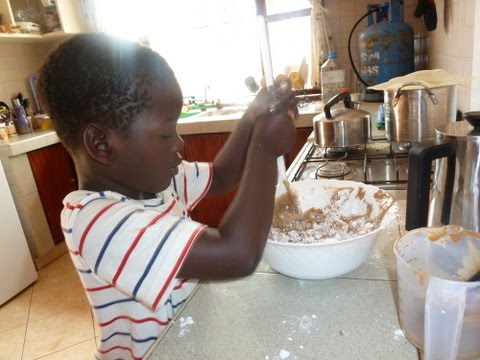
(Cooking with my extremely messy boy!)

If we were doing an international adoption in the USA, we'd have the "luxury" of hibernating as we get Moses settled... at least for some time.

Although our friends are interested in learning about our different child-rearing (i.e. discipleship and sheparding) concepts, it's still a foreign concept to make sacrifices in our day in order to train our children. And, as many of you know, any adoption takes lots of intense training and time.

I got the chance to take Moses out on a date today - just me and him at the coffee shop. We ran into a friend there who asked if Moses is a "quality time" kind of kid... I had to think hard about that... No, I think he's a quality-quantity kind of kid... i.e. very intense at this time!

I have intentionally spent good snuggle time and reading time with Moses, hoping to see him demonstrating less insecurity... no immediate results! (yes, I know over time it'll pay off, but as a mom of four young children, I'd love to see immediate results - haha!)

Instead, I need to structure every moment of his life - every second of his life. If I let my guard down for a moment, chaos ensues. If I allow myself to overlook any tiny disobedience, defiance spins out of control. (For all the children, not just Moses.)

There have been so many times in the last three months that I have had to say "no" to opportunities because my children have needed a highly structured life and constant training - chances to hang out with missionary moms, times to play at Home of Love, meetings, etc. Missionary moms understand. Acholi friends do not understand.

Yes, these insecure behaviors are normal and expected as this precious child adjusts to life in a family, life in English, life in ministry...

And Acholi children (in general) are allowed to be very disrespectful to women, especially, so my struggle to have a voice in his life (much improving, by the way!) is normal...

But it doesn't mean that we can overlook these behaviors. THIS is the intense time of training - an opportunity not to be missed. THIS is the foundation time for the rest of his life.

Needless to say, I hit the sack as soon as the children are quiet in their beds at night!

This is school holiday right now, so Home of Love children are home during the day and we have the opportunity to be providing activities for their discipleship and learning outside of school. We can't just hibernate. Last week we did a Vacation Bible School at Home of Love. This week we're doing small group discipleship with the older girls by having them come to our house for cooking lessons during the day. And we shower reassurance and love on all our children as we move forward with at least SOME of "daily" life, constantly reevaluating to make sure that we're not stretching Moses beyond his capacity.

No hibernating - but life sure does look different these days than my breakneck speed of life a year ago with only 3 children!

Comments

Popular posts from this blog

Uganda unit study - foods

Every tribe in Uganda has different food preferences, but they tend to revolve around these basics.  Boarding school students (i.e. the vast majority of secondary school students) generally eat posho and beans daily except for a Sunday portion of meat.  Imagine eating the same food for every meal! "Food" is the starch while everything else is the "soup" that goes with the food.  Generally a large quantity of the starch is portioned out with a smaller quantity of the soup. "Foods" include: White sweet potato (peeled and boiled) Cassava/manioc (as chips) Irish potatoes (peeled and boiled) White maize ( posho  - as a loaf of sticky "bread") Millet ( atapa or kalo - as a loaf of sticky "bread") Matoke /green plantain (best when steamed in banana leaves) Rice The "soup" includes a wide variety of ingredients in these categories: Greens Beans Cabbage Peanuts - ground into flour or paste depending on the tribe M...

Family of Three!

We are in Liberia - the electricity goes in and out because the generator is having trouble keeping up these days! So hopefully it will stay on long enough to post and the internet connection will allow me this luxury! We were united with precious Gracie on Thanksgiving day - I will write more about this later. But, oh! is Gracie a joy! She is so beautiful, so joyfilled, and a bit mischievious. Her physical limitations do not permit her to accomplish much mischief, but we can tell that she is trying to push some limits already. If we were not in love with her already, she is irresitable and such a treasure and blessing from God. In our two days together, she has not cried once. She spends most of her days smiling, she loves to snuggle (good match for us!), and has the most contagious laugh! Life takes more effort for her - her cerebral palsy is moderate and every activity is a challenge and is clearly tiring for her. Meal times (which she loves) take a long time and much patience and d...

Uganda unit study - facts

Uganda facts Kampala is the capital of Uganda. The Ugandan shilling is the currency used here (currently 3800 UGX to 1 USD). The official languages include English and Swahili, but people also speak Luganda and various other languages (like Acholi). The life expectancy in Uganda is 50.4 years. Uganda is a landlocked country bordered by Kenya in the east, Sudan in the north, Democratic Republic of the Congo in the west, Rwanda in the southwest and Tanzania in the south. Uganda’s total land area is 241,559 sq km. About 37,000 sq km of this area is occupied by open water while the rest is land. The southern part of the country includes a substantial portion of Lake Victoria, which it shares with Kenya and Tanzania. Uganda is located on the East African plateau, averaging about 1,100 meters (3,609 ft) above sea level. The plateau generally slopes downwards towards Sudan explaining the northerly tendency of most river flows in the country. Although generally equatorial, the clim...