
The great jackfruit adventure


In the market, I bought a knife dedicated to this adventure to save my one and only knife from the stickiness that is...

Josh brought home a huge jackfruit. Our Acoli friends decided that it was not quite ready yesterday, but today... today was the jackfruit day!

I am SO grateful for our Acoli friends who managed the jackfruit for me! This extremely sticky but yummy fruit is a lot of work to prepare! For Americans who are averse to any food that requires substantial work, jackfruit is NOT the fruit for you (hence why I am so grateful for our friends!).
The flesh is so very good raw, but, having some time, some friends to wrangle children while I cook, and some Acoli teenagers who are amazed at what I can do with a gas stove instead of charcoal, I wanted to try my hand at making jackfruit chips.
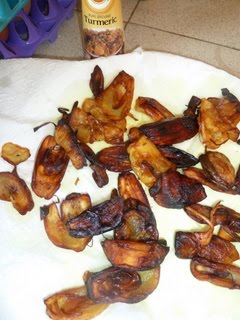
ALSO yummy! NOT healthy for you! A little tumeric, salt, and water thrown into the oil while frying and here's a simple but delicious way to cook jackfruit.

Comments

Jaime and Wes said…
Mmmm - jackfruit! I'd forgotten what it was exactly (we had it a few times in Cambodia, but not frequently). I never had to cut one open - looks like a lot of work. :) I do remember it was quite tasty (never had it fried - but anything is great fried!) ;)

Popular posts from this blog

Uganda unit study - foods

Every tribe in Uganda has different food preferences, but they tend to revolve around these basics.  Boarding school students (i.e. the vast majority of secondary school students) generally eat posho and beans daily except for a Sunday portion of meat.  Imagine eating the same food for every meal! "Food" is the starch while everything else is the "soup" that goes with the food.  Generally a large quantity of the starch is portioned out with a smaller quantity of the soup. "Foods" include: White sweet potato (peeled and boiled) Cassava/manioc (as chips) Irish potatoes (peeled and boiled) White maize ( posho  - as a loaf of sticky "bread") Millet ( atapa or kalo - as a loaf of sticky "bread") Matoke /green plantain (best when steamed in banana leaves) Rice The "soup" includes a wide variety of ingredients in these categories: Greens Beans Cabbage Peanuts - ground into flour or paste depending on the tribe M...

Family of Three!

We are in Liberia - the electricity goes in and out because the generator is having trouble keeping up these days! So hopefully it will stay on long enough to post and the internet connection will allow me this luxury! We were united with precious Gracie on Thanksgiving day - I will write more about this later. But, oh! is Gracie a joy! She is so beautiful, so joyfilled, and a bit mischievious. Her physical limitations do not permit her to accomplish much mischief, but we can tell that she is trying to push some limits already. If we were not in love with her already, she is irresitable and such a treasure and blessing from God. In our two days together, she has not cried once. She spends most of her days smiling, she loves to snuggle (good match for us!), and has the most contagious laugh! Life takes more effort for her - her cerebral palsy is moderate and every activity is a challenge and is clearly tiring for her. Meal times (which she loves) take a long time and much patience and d...

Uganda unit study - facts

Uganda facts Kampala is the capital of Uganda. The Ugandan shilling is the currency used here (currently 3800 UGX to 1 USD). The official languages include English and Swahili, but people also speak Luganda and various other languages (like Acholi). The life expectancy in Uganda is 50.4 years. Uganda is a landlocked country bordered by Kenya in the east, Sudan in the north, Democratic Republic of the Congo in the west, Rwanda in the southwest and Tanzania in the south. Uganda’s total land area is 241,559 sq km. About 37,000 sq km of this area is occupied by open water while the rest is land. The southern part of the country includes a substantial portion of Lake Victoria, which it shares with Kenya and Tanzania. Uganda is located on the East African plateau, averaging about 1,100 meters (3,609 ft) above sea level. The plateau generally slopes downwards towards Sudan explaining the northerly tendency of most river flows in the country. Although generally equatorial, the clim...